

Experts Play the Most Crucial Role in Higher Education Accreditation Reviews
Organized by the project "EU Support to Education Policy in Serbia" and the National Entity for Accreditation and Quality Assurance in Higher Education (NEAQA), a "Train the Trainer" seminar for future instructors of reviewers in the accreditation process of higher education institutions and study programs was held in Belgrade on February 6, 2026.
The objective of the training, attended by professors from the Universities of Belgrade, Nis, and Novi Sad, as well as representatives from the NEAQA and the Commission for Accreditation and Quality Assurance (CAQA), was to acquire competencies for training reviewers and to facilitate the exchange of experience in conducting training sessions for new reviewers who require necessary knowledge and skills for the accreditation process.
The training was led by Dr. Achim Hopbach, an international higher education expert engaged in the project and former President of the European Association for Quality Assurance in Higher Education (ENQA).
Prof. Dr. Nebojsa Zdravkovic, Director of the NEAQA emphasized the importance of accrediting higher education institutions and study programs performed by university faculty, as well as the significance of involving new reviewers through the open call published on the NAT official website.
The NEAQA performs activities of accreditation and quality assurance of higher education institutions and their units, evaluation of study programs and quality assurance in higher education in Serbia. In the first part of the training, Dr. Hopbach spoke about the role of the trainer and what constitutes effective training.
"University professors are unique as training participants. They are experts in their fields, they educate and train. Participating in reviews is a very complex and unusual task. The review is based on explicit regulations and implicit specialist expertise. Experts play the most important role in the review, and their autonomy is not limited by regulations," Dr. Hopbach pointed out, emphasizing that "training is less about knowledge and more about competencies. A good training program is no guarantee of a good and correct review implementation."
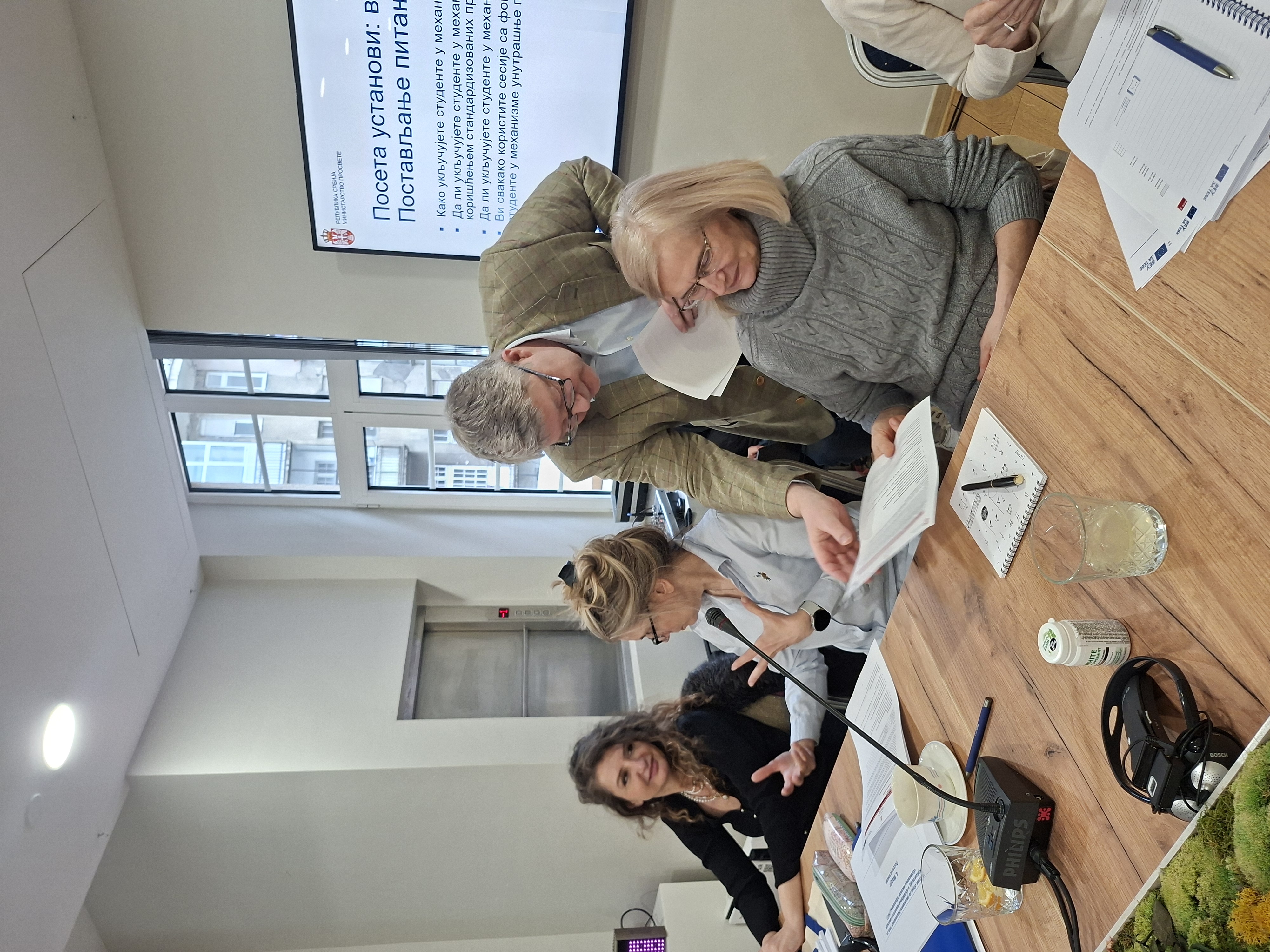
The seminar continued with the presentation of the training program through several modules: Module 1 – External Quality Assurance; Module 2 – Reviews and Reviewers; Modules 3a–3e – Standards; Module 4 – Site Visit; and Module 5 – Assessment and Report Writing.
At the end of the training, a simulation of an interview session during a site visit (Module 4) was held through practical work, during which the review commission conducts interviews with a mixed group of representatives from the higher education institution. The purpose of the simulation was to highlight the importance of preparing for and conducting the interview.
The training is part of a project component providing support for improving the fairness, quality, and relevance of the education system. The project aims to strengthen institutional and human capacities in the education sector to ensure the implementation of reform processes. Consequently, several project activities are focused on cooperation with the NEAQA, particularly in the areas of the NEAQA's internal quality assurance, support for the internal quality assurance of higher education institutions, optimization of external quality assurance processes, and the training of reviewers for the accreditation process.
The EU is the largest partner of the Republic of Serbia in modernizing the education system. Since 2003, the EU has donated over €130 million for education reform at all levels, aiming to strengthen the role of education as a foundation for social and economic development.